

The rise of independent Deaf community technology represents an urgent turning point in a world engineered exclusively around auditory norms. For centuries, hearing-dominant societies have viewed deafness purely through a medical deficit lens, pushing Deaf individuals to the margins under the guise of “normalcy.” Sociological and cognitive research consistently demonstrates that the most disabling aspect of being Deaf does not originate from an inability to hear; rather, it stems from systematic auditory prejudice, social exclusion, and the constant policing of how Deaf people naturally exist. Overcoming these deep-seated barriers requires acknowledging why superficial accommodations fail—and why purpose-built Deaf community technology is essential for collective sovereignty.
Auditory Bias and the Social Policing of Natural Expression
In public and professional spheres, Deaf individuals routinely face social scrutiny from those who consider themselves the baseline of human existence. A glaring example occurs during natural, face-to-face communication: when Deaf people converse in sign language, organic non-verbal vocalizations and physical resonances are naturally produced.
Instead of being accepted as normal linguistic dynamics, these vocal expressions are frequently met with visible discomfort, stares, and social disapproval in hearing-centric environments. Mainstream society subtly demands an auditory etiquette, expecting Deaf individuals to suppress their presence to keep hearing bystanders comfortable.
The traditional response from institutions has always been forced assimilation—demanding that Deaf people “blend into society” and adapt to environments designed to erase their identity. Real progress, however, is not achieved by asking Deaf individuals to hide their natural communication. It requires deploying modern tools that validate our natural expression without compromise.
The Psychology of Dinner Table Syndrome and Early Exclusion
Long before facing barriers in public spaces, social marginalization often begins within the domestic environment. Developmental psychologists term this phenomenon the “Dinner Table Syndrome”—the chronic communicative isolation experienced by Deaf children and adults in hearing family environments.
Key characteristics documented across developmental studies include:
- Multi-speaker hearing conversations shift rapidly, leaving visual communicators entirely unable to track conversational context or emotional nuances.
- Natural inquiries such as “What are you talking about?” are persistently dismissed with phrases like “It is nothing” or “I will tell you later.”
- This chronic lack of incidental learning during formative years elevates baseline anxiety and reinforces linguistic confinement.
When home environments lack fluent visual signing, individuals miss out on unstructured social intelligence. Dedicated Deaf community technology bridges this generational divide by offering accessible visual networks that cultivate connection outside hearing-only barriers.
The Flaws of Conventional Assistive Tools
For decades, mainstream corporations have built software solely for the hearing majority, later attaching superficial accessibility features as an afterthought. Deaf individuals have consistently been pressured to adapt to broken, inadequate tools that treat visual language as an inferior alternative.
Unreliable automated speech-to-text algorithms, sound-dependent alerts, and voice-activated interfaces only widen the digital divide. Forcing visual thinkers into audio-centric operating systems traps users in perpetual technological dependency. We cannot achieve equality by relying on digital frameworks that fail to understand spatial and visual cognition.
Why Deaf Community Technology Must Be Built by Deaf Minds
The true solution to marginalization is not passive assimilation into systems built against us. The path forward requires utilizing state-of-the-art technological resources to establish an uncompromised presence across every dimension of modern life.
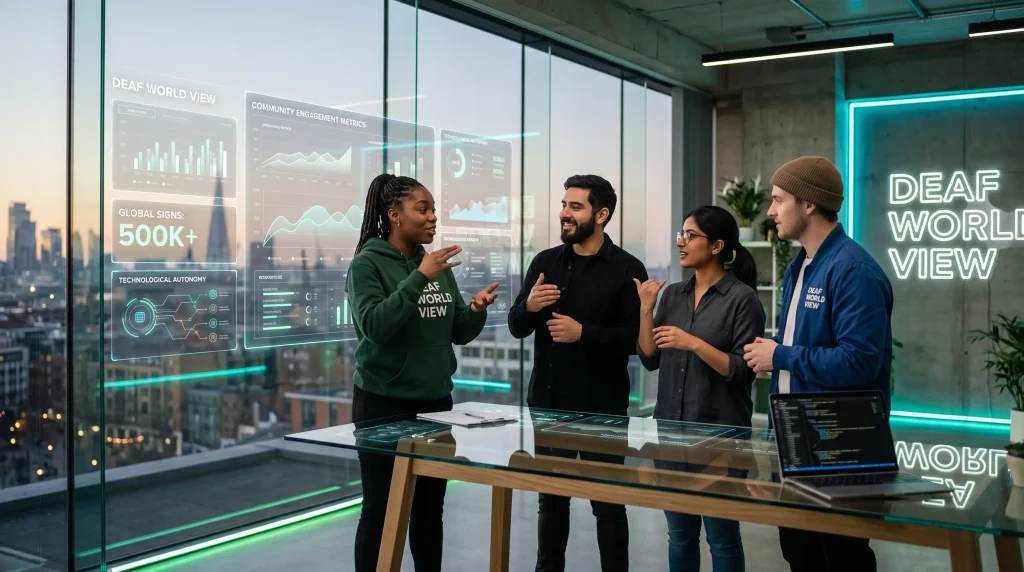
Instead of adapting traditional, hearing-centric software to fit our needs, we are creating our own digital ecosystem. Through Deaf World View, we are engineering visual-first mobile applications, independent communication networks, and decentralized hubs designed by Deaf innovators for the global Deaf population.
By connecting an international community of over 500,000 members, our mission establishes true technological self-determination. We do not seek permission to integrate into tools built for others; through dedicated Deaf community technology, we are building the digital infrastructure that ensures our lasting autonomy.
