
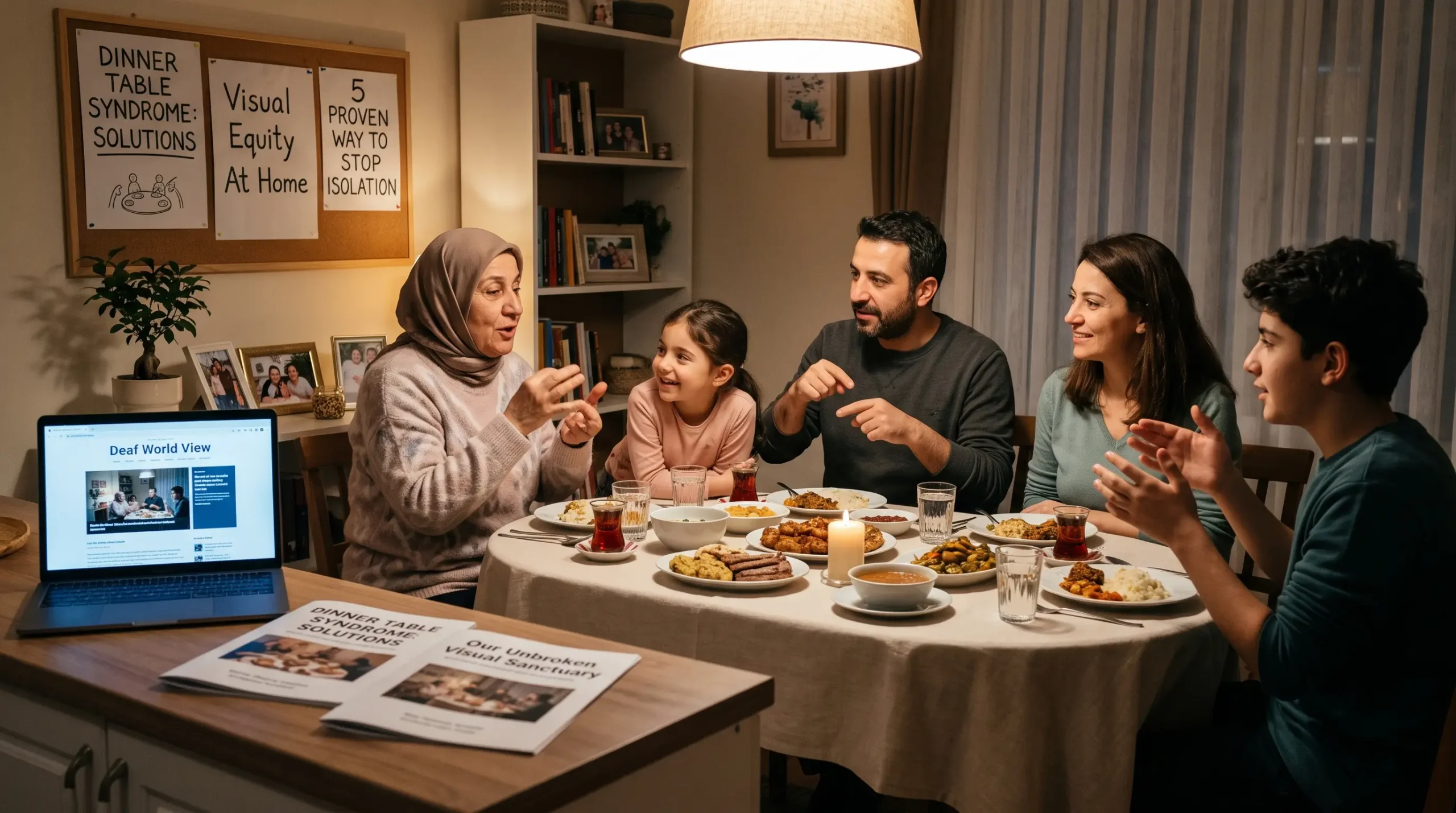

Implementing actionable Dinner Table Syndrome solutions is one of the most urgent social and psychological frontiers for our global collective. Across sociolinguistic literature, “Dinner Table Syndrome” defines the pervasive communicative isolation experienced by Deaf and hard of hearing individuals within their own hearing family circles. When meals, familial gatherings, and casual household interactions unfold entirely through rapid, overlapping spoken dialogue, the visual individual is systematically excluded from everyday incidental learning, emotional bonding, and spontaneous cultural socialization.
This domestic alienation is rarely intentional; nevertheless, its long-term psychological impact is profound. Over 90% of Deaf children are born to hearing parents, meaning that the overwhelming majority of visual communicators spend their formative years navigating communicative starvation in their closest environments. Confronting this chronic challenge requires systemic understanding, practical tools, and independent digital communities that provide immediate peer solidarity.
The Psychological Toll of Incidental Learning Deprivation
In developmental psychology, incidental learning—the informal absorption of cultural norms, humor, family history, and social dynamics occurring organically in domestic environments—accounts for a vast portion of human cognitive and emotional development. When a visual member is routinely excluded from these ambient interactions, the consequences extend far beyond momentary awkwardness.
Longitudinal psychological studies documented by behavioral research centers at Gallaudet University illustrate the systemic fallout of chronic domestic exclusion:
- Linguistic Deprivation Trauma: Irregular or delayed access to fluid, natural dialogue induces chronic cognitive fatigue, social anxiety, and feelings of hyper-invisibility.
- Internalized Marginalization: Repeatedly receiving dismissive responses like “I will tell you later” or “It was nothing” teaches young visual individuals that their comprehension is a communal burden.
- Impaired Social-Emotional Buffering: Lacking direct domestic peer support leaves visual individuals vulnerable when facing educational or corporate discrimination later in life.
Dismantling this barrier is not merely an interpersonal family issue; it is a foundational public mental health imperative.
Moving Beyond Interpersonal Frustration to Structural Frameworks
For decades, the standard guidance offered to families was strictly clinical: oralist speech therapies, auditory amplification devices, or individual behavioral modifications. However, modern sociolinguistics demonstrates that communicative barriers are structural, not individual deficits. A home cannot be truly inclusive if only one individual is expected to shoulder the entire burden of translation.
International research synthesized by human rights agencies such as the World Health Organization underlines that early access to fully accessible, unhindered communication is non-negotiable for holistic developmental well-being. True inclusion begins when hearing families embrace visual communication practices, transforming the domestic dining table from a site of emotional exclusion into a shared visual learning space.
5 Proven Structural Solutions for Domestic Inclusion
To establish sustainable domestic equity, our community advocates for concrete, actionable paradigms:
1. Universal Visual Signing Environments
Encouraging hearing family members to adopt conversational sign fluency, establishing the home as a shared visual space rather than an auditory obstacle course.
2. Spatial and Environmental Architecture
Reconfiguring domestic seating into round tables with open sightlines and glare-free illumination, ensuring every family member can read kinetic expressions clearly.
3. Dedicated Peer Support Networks
Connecting visual children and adolescents directly with adult community role models through Deaf World View, providing crucial external social capital and cultural validation.
4. Abolishing the “Tell You Later” Dynamic
Establishing household rules that eliminate communicative brush-offs, ensuring visual individuals receive simultaneous, equitable access to shared jokes and family news.
5. Sovereign Visual-First Digital Community
Developing independent social software platforms where individuals experiencing domestic isolation can instantly access 24/7 video dialogue with 450m+ visual peers worldwide.
Constructing an Unbroken Visual Sanctuary
No individual should ever feel like a detached spectator within their own family home. While domestic dynamics can take generations to heal, independent community networks offer an immediate, empowering sanctuary where visual communication is celebrated without friction.
By organizing our collective strength across 450m signs, we are turning historical isolation into collective resilience. Through dedicated Dinner Table Syndrome solutions and sovereign community-led platforms, we ensure that every visual mind finds its authentic voice, its cultural home, and its rightful place in our shared future.